


Blog
Monday, September 16, 2013
"Rare Talent, Imperfect Art" at THE MILLIONS
It's been a while since I've been here--had to dust things off a bit. But happy to report that I have an essay on teaching, up at The Millions today: http://www.themillions.com/2013/09/rare-talent-imperfect-art.html. I do some soul-searching here, which made it challenging--but also rewarding--to write. Please share if you know of others who might like to read it. And let me know what you think!

Tuesday, March 12, 2013
Alone in His Own Character
The great, gashed, half-naked mountain is another
of God’s saints.
There is no other like him.
He is alone in his own character,
nothing else in the world ever did or ever will imitate God
in quite the same way.
That is his sanctity.
--Thomas Merton, from New Seeds of Contemplation

Back from a week at a retreat center in the Sangre de Cristo range of the Colorado Rockies, trying to hold on to images like this one--and also to these and other words from Thomas Merton--during today's dreary Pennsylvania rain . . . .
Friday, February 22, 2013
Recommended Reading--Cybercrime or Typical Academic Pettiness?
I’ve been fascinated by the story of Raphael Golb, who created countless online identities in order to address what he saw as biased and unjust attitudes toward his father’s scholarly work on the Dead Sea Scrolls, for several years now. In fact, when I first read about the discovery that Golb had created online aliases, blog posts, comments, etc. in order to smear his father’s rivals, his case became a kind of inspiration for parts of my current novel-in-progress.
John Leland’s article in the Metropolitan section of last Sunday’s New York Times (“Online Battle Over Sacred Scrolls, Real-World Consequences”) is a sensitive and nuanced account of the whole affair. Mostly it strikes me as a sad story of two pretty unhinged men (both Raphael and his father Norman Golb). But it does raise interesting questions about First Amendment rights and academic debate, and what counts as criminal activity in the Wild West of the cyber-universe.
Saturday, January 12, 2013
Gaggle and Rookery
I was invited to offer the prayer at one of last December's Moravian College Christmas Vespers concerts. It's a gorgeous event each year, with my friend Paula Zerkle conducting the College Choir, and I was thrilled to join Chaplain Hopeton Clennon and others on the dais of Central Moravian Church that evening and look out on the sea of lit candles that fill the sanctuary and balcony at the end of the service.
Thought I'd share the prayer I wrote here, since it didn't actually have that much to do with Christmas per se. Somehow I managed to get birds in there instead.
P.S.: I'm certainly no videographer, especially with an iPhone that I don't use very intelligently, but I did try recently to capture some of these remarkable groups of crows that descend on the treetops of center city Bethlehem at dusk each day. So I'll include that little bit of video here. (Pardon the roar of traffic; the fact that you can still hear the crows over the noise of cars gives you some sense of how loud they are.)
Thought I'd share the prayer I wrote here, since it didn't actually have that much to do with Christmas per se. Somehow I managed to get birds in there instead.
To begin, the words of a Sabbath poem by writer Wendell Berry:
Teach me work that honors Thy work,
the true economies of goods and words,
to make my arts compatible
with the songs of the local birds
Teach me patience beyond work
and, beyond patience, the blest
Sabbath of Thy unresting love
which lights all things and gives rest.
Let us pray.
Dear Giver of light, and of rest; dear Source of pure songs rising from this dark season,
Thank you for these songs--these glorious voices, these cherished instruments, from quietest flute to unstopped organ. Thank you for the youthful hopes and dreams of our students, your children here and throughout the world, who sing and play and praise you, in sounds that are beautifully compatible with the songs of the local birds.
Sustain their hopes and dreams, with your unresting love, even in dark times.
With your unresting love, teach us all--all of us gathered here tonight, all of us throughout the world--to honor true economies of goods and words. To respect and revere both the makers of art and music and the makers, and maintainers, of our communities and our homes. Those who care for our children and our elders. Those who teach, those who govern, those who build, those who cook, and clean, and nourish.
In this season of dark and quiet, teach us to rest in your unresting love. To acknowledge, and attend to, the needs of others. To attend to, and to value, the boundless gifts of the natural world. To listen with restful patience, and deep appreciation, to tonight’s sublime music, but also to the raucous cries of a gaggle of geese or a rookery of crows.
We are grateful to you for the opportunity to rest, tonight, in the beautiful light of this sanctuary and in these sounds of heartfelt praise. Help us, when we leave, to carry this light and these sounds with us, and to share both, in whatever ways we are able, with others.
Amen.
P.S.: I'm certainly no videographer, especially with an iPhone that I don't use very intelligently, but I did try recently to capture some of these remarkable groups of crows that descend on the treetops of center city Bethlehem at dusk each day. So I'll include that little bit of video here. (Pardon the roar of traffic; the fact that you can still hear the crows over the noise of cars gives you some sense of how loud they are.)
Tuesday, January 8, 2013
"I Thought You Were a Dwarf"
There are writers and artists that I turn to, often in the cold and dark winter months, to remind me of why it’s important to persist. Persist in the work of writing fiction, or any work of making something that isn’t particularly profitable. “Money dignifies what is frivolous if unpaid for,” wrote Virginia Woolf in A Room of One’s Own--not necessarily approving of this state of affairs, of course.
But there you have it: that nagging sense of something that’s “unpaid for” being frivolous. The reason, no doubt, that I devoted much more time to editing and then teaching, from my twenties through my forties, than to my own writing.
There are ways to make money as a writer, but I haven’t been good at honing those skills. Jokes about “slutting it up” (in my friend and fellow Quaker Rick’s words at a meeting last night) and “inserting a vampire or two” aside, I seem constitutionally incapable of devising hair-raising plots. Or even--in language I’m hearing a lot of lately, as my agent begins submitting a new novel manuscript, with pretty clear trepidation-- “a strong through-line narrative.” I know, I want to tell her: Gone Girl it’s not. I’m sorry, but I don’t really think I can help it.
My impulse is to get whiny and defensive at these moments. Maybe to fall back on the old “They’d never say that to a man” response. (And yes, I can hear how hollow that rings in answer to the charge of a weak “through-line narrative.”) But how about the charge of “too much autobiography”--which, yes, I’ve already heard in response to this new manuscript. (What’s particularly upsetting is that this isn’t even true.)
But a better path, for me, than the angry, arched-spine, “when-did-you-last-say-something-like-that-about-a-male-writer’s-work” posture I’m prone to, is to read someone like Ursula Hegi, in a piece called “Did This Really Happen to You?” that appeared on the Glimmer Train site some time ago. “Giving a character one of my experiences changes the experience,” Hegi writes. “Brings me into the character from an angle I have experienced. Opens up anew the mystery of how it all comes together.”
Give me that “mystery of how it all comes together” over the manipulation of a heavily plotted thriller or vampire story any day.
And also, please give me Ursula Hegi’s calm and gracious equipoise in the face of repeated versions of the question “Did this really happen to you?” When, after publishing Stones from the River, Hegi encountered readers who told her, “I thought you were a dwarf,” her answer was a simple one. She thanked them.
Tuesday, December 11, 2012
Our Cat Litter Box, Exposed
I've been rethinking the photo showing the cat litter box on our little sun porch in this "Where Writers Write" post at The Next Best Book Blog . . . . Now it's online for perpetuity!
This is the kind of thing I think about too much: how ephemeral our digital lives are, and how alarmingly permanent at the same time.

This is the kind of thing I think about too much: how ephemeral our digital lives are, and how alarmingly permanent at the same time.
Thursday, November 15, 2012
Writing and Napping
There have been some great tips from writers on the Unbridled Books tumblr page this month--in a feature inspired by National Novel Writing Month (NaNoWriMo). My advice is there too, under the heading "Write immediately . . . nap often"--which is a little deceptive, since my advice follows up on my only wishing I had time to take naps.
Anyway: there are lots of good ideas there, so check them out, whether you're writing a novel this month or not!
Anyway: there are lots of good ideas there, so check them out, whether you're writing a novel this month or not!
Sunday, September 30, 2012
Female Sidekicks in Fiction?

Attention Pacific Northwest readers and friends: I'll be at the Wordstock Festival in Portland, OR on Saturday, Oct. 13--reading with Lois Leveen at 2 PM, and on a panel on "literary sidekicks" with Kim Barnes and Martha Grover at 5 PM. See the Events page of my web site for details.
And readers and friends everywhere: Please help me as I try to put together some thoughts on "literary sidekicks." I'll be talking mostly about my characters Maze and Mary Elizabeth in Stranger Here Below, but I'm interested in other female characters who are friends (in novels or short stories), and particularly friendships that cross racial lines. I'm struck by the fact that I can think of all kinds of literary examples of male buddies/sidekicks, but it's harder to think of females (and hard in both cases to think of that many that cross the boundary of race). Sethe and Denver in Toni Morrison's Beloved, central characters in Alice Walker's "Advancing Luna--and Ida B. Wells," characters in Katherine Anne Porter's The Old Order. And who else?
And why can I think immediately of female buddy films but not female buddy literary novels?
Tuesday, September 18, 2012
Entertain Us
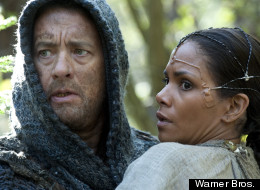
Well, I’ve watched the trailer for the film of David Mitchell’s Cloud Atlas now, and I still can’t decide what I think.
I thought I must have misheard or misread when I got the news, somewhere, that the Wachowski siblings were making a film of the novel--which was published in 2004, and offered one of the most potent and moving reading experiences I’ve had in the last ten years. But then I read the Aleksander Hemon article in the September 10 issue of the New Yorker.
I found that article exhilarating, probably because, for once, I was reading about the making of a movie through the eyes, and in the words, of a fine writer. Reading about Andy and Lana Wachowski and Tom Twyker’s experience in adapting the novel for the screen was exhilarating. Three smart, creative people, in love with a book and in love with film, working doggedly to bring it together--and this story told by a fourth smart, creative person. When I finished the article I had to get up and walk around for a while-- which is often my reaction to something creative and exciting.
Reading about the filmmakers’ difficulty in securing funding, and their despair over the lack of originality in Hollywood studios’ vetting of films (recounted in this Huffington Post piece), made me root for this film. But then the next day I saw a picture in our local paper, in an article about upcoming fall films: Tom Hanks and Halle Berry in strange, half-primitive, half-futuristic make-up and costumes. And my heart sank.
It’s not that I don’t like these actors; I like them a lot. It’s just that they are so deeply connected, in my mind, with Hollywood, with fantasy and spectacle and a certain mindlessness when it comes to storytelling and entertainment. I couldn’t bear the thought of their assuming roles from this novel I’d so loved--the only novel I’ve finished in a flood of tears in a very long time. I couldn’t imagine their Hollywood bodies and faces in anything that wouldn’t diminish the experience of Cloud Atlas for me.
It’s partly that so much of the pleasure and power of Cloud Atlas the novel comes from its language. It’s difficult and unwieldy language at times, and it makes the kind of demands on a reader that so few (successful) creative works make today. Now people will know the novel as the source for a lavish--and, I’m sure, deeply moving--visual spectacle. But they probably won’t know it for its original, challenging, and heartbreakingly beautiful language. And I think that’s a terrible loss.
Here we are now, entertain us. Even that line from Nirvana is a dated reference now, I realize. But it still haunts me, in an age when college students can say that they enjoy “more traditional lectures”--by which they mean speakers who use a lot of Powerpoint. And that while we’re on that subject, why can’t they just watch the thing online?
The quiet pleasure of words, written or spoken: will we eventually lose this? Will I just be one of a handful of dinosaurs who mind?
Friday, August 3, 2012
The Game of Life
A new experience for me this summer: getting letters from my daughter at camp. Can there be anything more exhilarating than getting a letter from your almost-eleven-year-old that begins "The second day has been equal in its awesomeness to the first day"? She's having fun; I can relax.
In July I had two wonderful weeks in New England--first on Cape Cod with two of my oldest and dearest friends, Rita and Eva, to celebrate our "big birthday" this year. I'm not being coy; I just get tired of saying it. Let's just say that one of the books I took along was Tracey Jackson's Between a Rock and a Hot Place: Why Fifty Is Not the New Thirty. Another was Emma Donoghue's Room, which I'd wanted to read but kind of dreaded reading too (a cross between dread of reading about a child being held captive and, I'll admit it, dread of the inevitable envy of another writer's success). But it was every bit as good as I'd been told, surprising in a number of ways, and it made me feel the admiring kind of envy that I don't mind.
On the Cape we had fun biking, cooking, exploring different beaches and making lots of jokes about being middle-aged. (For example, our version of the Portlandia episodes where Lisa and Bryce put birds on things or exclaim "We could pickle that!" was our response to any leftover food item, at home or in a restaurant: "We could put that on a salad!" Middle-aged women love thrifty and creative salads). But I'm pleased to say there was also some good old-fashioned sexual humor, of the sort we might have indulged in while in college; ask my friend Eva for her interpretation of the name of the Dennisport, MA restaurant called The Wee Packet.
The second week was my yearly trip to Vermont with Jim and Anna, staying at the wonderful Pie in the Sky in Marshfield and enjoying time with friends who stay nearby. This was the year for playing The Game of Life with Anna and her friend Kathleen, who were both obsessed with it for some reason. Remember that board game? In one rendition I was a gay male in an orange car, starting out as a doctor making $70,000/year (presumably the version of the game we were playing was a few years old . . . though it did feature "Tech Support Person" as one possible job), then dropping to $30,000/year (no explanation, but I assumed malpractice of some sort), then switching careers, to sales, and making $60,000. I had a partner but never had kids or did anything with the cheap fixer-upper I bought--though I did install an expensive at-home gym. (Please remember that most of these "life choices" are based on the spaces you land on and the cards you draw, which might sort of be the point, in an existential sense; I'm not sure.) I retired to the place called Country Estates--not Millionaire Estates, where Anna and Kathleen both retired at the game's end--with a total of $635,000 in money and assets, as opposed to Anna and Kathleen's millions.
Here was something particularly intriguing: Though I wanted to play more recklessly, foregoing the purchase of car and home insurance and choosing not to repay my college loans (in other words, being the carefree person I've never quite been able to be), every time we played I felt incredible pressure to do these responsible things because the two ten-year-olds I was playing with kept purchasing every possible form of insurance and repaying loans as soon as they could. What was that all about?
Two photos here, one from a walk on the beach at Monomoy National Wildlife Refuge off the elbow of Cape Cod, one of the sun porch and barn at Pie in the Sky.


In July I had two wonderful weeks in New England--first on Cape Cod with two of my oldest and dearest friends, Rita and Eva, to celebrate our "big birthday" this year. I'm not being coy; I just get tired of saying it. Let's just say that one of the books I took along was Tracey Jackson's Between a Rock and a Hot Place: Why Fifty Is Not the New Thirty. Another was Emma Donoghue's Room, which I'd wanted to read but kind of dreaded reading too (a cross between dread of reading about a child being held captive and, I'll admit it, dread of the inevitable envy of another writer's success). But it was every bit as good as I'd been told, surprising in a number of ways, and it made me feel the admiring kind of envy that I don't mind.
On the Cape we had fun biking, cooking, exploring different beaches and making lots of jokes about being middle-aged. (For example, our version of the Portlandia episodes where Lisa and Bryce put birds on things or exclaim "We could pickle that!" was our response to any leftover food item, at home or in a restaurant: "We could put that on a salad!" Middle-aged women love thrifty and creative salads). But I'm pleased to say there was also some good old-fashioned sexual humor, of the sort we might have indulged in while in college; ask my friend Eva for her interpretation of the name of the Dennisport, MA restaurant called The Wee Packet.
The second week was my yearly trip to Vermont with Jim and Anna, staying at the wonderful Pie in the Sky in Marshfield and enjoying time with friends who stay nearby. This was the year for playing The Game of Life with Anna and her friend Kathleen, who were both obsessed with it for some reason. Remember that board game? In one rendition I was a gay male in an orange car, starting out as a doctor making $70,000/year (presumably the version of the game we were playing was a few years old . . . though it did feature "Tech Support Person" as one possible job), then dropping to $30,000/year (no explanation, but I assumed malpractice of some sort), then switching careers, to sales, and making $60,000. I had a partner but never had kids or did anything with the cheap fixer-upper I bought--though I did install an expensive at-home gym. (Please remember that most of these "life choices" are based on the spaces you land on and the cards you draw, which might sort of be the point, in an existential sense; I'm not sure.) I retired to the place called Country Estates--not Millionaire Estates, where Anna and Kathleen both retired at the game's end--with a total of $635,000 in money and assets, as opposed to Anna and Kathleen's millions.
Here was something particularly intriguing: Though I wanted to play more recklessly, foregoing the purchase of car and home insurance and choosing not to repay my college loans (in other words, being the carefree person I've never quite been able to be), every time we played I felt incredible pressure to do these responsible things because the two ten-year-olds I was playing with kept purchasing every possible form of insurance and repaying loans as soon as they could. What was that all about?
Two photos here, one from a walk on the beach at Monomoy National Wildlife Refuge off the elbow of Cape Cod, one of the sun porch and barn at Pie in the Sky.


Wednesday, July 25, 2012
Summer Vacation
Nourishing myself, body and soul, during our annual week in Vermont right now. Here's a photo of breakfast a couple days ago (made with my daughter's help).


Wednesday, June 20, 2012
Some Summer Reading Lists
I've meant to post the following book lists since the STRANGER HERE BELOW paperback launch on June 1. Now, back from travel to visit family in the Midwest (southern Michigan, southern Indiana, and Cincinnati, with husband, daughter, and new puppy along), I'm finally getting around to it.
The paperback launch at the Moravian Book Shop was also a celebration of area book groups and area authors, so the first list I'll include here is a list of books by Lehigh Valley (PA) authors, many of whom came to the Book Shop on June 1. Second is a really random list of novels I've particularly enjoyed in the last few years. I'm always asked what books I especially like, and it's always too hard to answer that question on the spot. I'm sure I've left some wonderful novels off the list I'm including here, but at least it's a place to start.
It's summer! And it's supposed to hit the upper 90s here in eastern PA by tomorrow. A good time to grab a book and a cold drink, find some shade, and start reading.
The paperback launch at the Moravian Book Shop was also a celebration of area book groups and area authors, so the first list I'll include here is a list of books by Lehigh Valley (PA) authors, many of whom came to the Book Shop on June 1. Second is a really random list of novels I've particularly enjoyed in the last few years. I'm always asked what books I especially like, and it's always too hard to answer that question on the spot. I'm sure I've left some wonderful novels off the list I'm including here, but at least it's a place to start.
It's summer! And it's supposed to hit the upper 90s here in eastern PA by tomorrow. A good time to grab a book and a cold drink, find some shade, and start reading.
Books by Lehigh Valley, PA Authors
Paul Acampora, RACHEL SPINELLI PUNCHED ME IN THE FACE; DEFINING DULCIE
Bathsheba Monk, NOW YOU SEE IT . . .: STORIES FROM COKESVILLE, PA; NUDE WALKER
Alix Ohlin, THE MISSING PERSON; BABYLON AND OTHER STORIES; INSIDE; SIGNS AND WONDERS
A Random List of Some of Joyce’s Recent Favorites
Barbara Kingsolver, THE LACUNA
Per Petterson, OUT STEALING HORSES
Jennifer Egan, A VISIT FROM THE GOOD SQUAD and THE KEEP
Teju Cole, OPEN CITY
Louise Erdrich, SHADOW TAG
David Mitchell, CLOUD ATLAS and THE THOUSAND AUTUMNS OF JACOB de ZOET
Marilynne Robinson, GILEAD and HOME
Wendell Berry, JAYBER CROW
Helon Hebila, OIL ON WATER
Kate Walbert, A SHORT HISTORY OF WOMEN and THE GARDENS OF KYOTO
Thursday, June 7, 2012
Go Rovers!

Yesterday I spent a wonderful afternoon with this fine group of AP English students from Easton Area High School here in PA, and their teacher, my friend Sarah Wascura. They asked some of the most probing and intelligent questions I've been asked about Stranger Here Below, which they read during these last weeks of their senior year, God bless them. And God bless the remarkable Mrs. Wascura (and her daughter Emily, who graciously snapped this photo) for hosting us all. I had such a good time talking with these students about the book and about their future plans--and I even got to hear several of them (fine musicians besides being smart and thoughtful readers) perform a few songs from Wicked.
Their future college professors--at Ithaca College, Syracuse, Columbia, Muhlenberg, Rochester, and other schools--are lucky to get them. I wish them well, and I'm so grateful to Sarah for her tireless support of my work, and also for her deep commitment to teaching.

Thursday, May 24, 2012
Revisiting the Birds
A wonderful evening last night at Muhlenberg College, with members of the AAUP Book Club, who read In Hovering Flight. Also invited was Dan Klem, Sarkis Acopian Professor of Ornithology & Conservation Biology at Muhlenberg, who was my invaluable advisor on all things bird-related during the writing of In Hovering Flight.
It was great to revisit the book with this smart and thoughtful group of readers, and especially nice to see Dan and hear stories about his own boyhood love of birds, as well as his work now, on birds and windows.
Special thanks to Helene Marshall for arranging the evening--and for taking the photo of Dan and me that I'm including here.

It was great to revisit the book with this smart and thoughtful group of readers, and especially nice to see Dan and hear stories about his own boyhood love of birds, as well as his work now, on birds and windows.
Special thanks to Helene Marshall for arranging the evening--and for taking the photo of Dan and me that I'm including here.

Friday, May 11, 2012
As I try to write about nostalgia without becoming sentimental or maudlin . . .
I have been feeling quite nostalgic for the last few months. I know that part of this is simply being of a certain age now, and part of it is watching my daughter grow and change so rapidly, slipping out of my fingers somehow, slipping out of childhood. She’s nearing eleven now, so of course still a child--but at this point you can see all the changes coming. (Most of them are good, I might add; she’s funny, and kind, and mostly generous. She’s also whip smart and can be bitingly sarcastic, which unnerves me a little as I brace for the years ahead.)
Being in Chicago at the beginning of March, for the AWP Conference, really set off a long, strange bout of nostalgia for me. I lived in Chicago in the late 1980s, and while I was mostly struck by the giant changes in that city, particularly downtown, along Michigan Avenue, I also had a few moments of remembering my younger self, living there, riding to Wicker Park on my boyfriend’s motorcycle, driving along Lake Shore Drive, home to Evanston, from my job selling tickets at a little theatre in a hotel in the South Loop.
I had breakfast in the restaurant of that hotel, the Blackstone, this past March, and the box office window, just off the lobby, had been boarded up. There was a big plant in front of it, I think. And the crappy coffee shop on the ground level was now an overcrowded Starbucks.
So, that kind of thing.
But here’s something else I’m feeling nostalgic for, today. For weeding the strawberries in our garden with one or the other of my older brothers when I was a kid. I’m remembering one particular occasion when I was doing this, I think with my brother Stu. I have no recollection of how old I was, but I know that somehow we got on the subject of boys and girls liking each other, and somehow Stu remarked, off-handedly, that it was also true that some boys liked other boys and some girls liked other girls. Or something like that; I don’t remember his exact words, or why he was telling me that. What I remember was that it was no big deal. Just something I might want to know.
I find that remarkable, now. And I miss a time and place and older brothers with whom such an exchange was possible. I miss it particularly now, as I sign various petitions in support of President Obama’s having come out in favor of gay marriage. I’m signing them willingly enough, but also with a weird sort of impatience. Should this really be such a big deal? I keep thinking. Shouldn’t we all just get on with things, acknowledge that boys can like boys and girls can like girls, and so that’s probably who they should marry, and then get back to weeding the strawberries?
Friday, April 27, 2012
Sacred Places
As I expected, sitting and talking about poetry with a small group of Quakers--in a room with lovely woods and a stream right outside the door--was pretty wonderful. Several of us took a brief walk beforehand, and found a deep purple trillium blooming in the crook of a tree trunk.
In honor of last weekend, these lines from Wendell Berry's "How to Be a Poet" (from his 2005 collection GIVEN):
Stay way from anything
that obscures the place it is in.
There are no unsacred places;
there are only sacred places
and desecrated places.
Happy weekend. Find some sacred places.

In honor of last weekend, these lines from Wendell Berry's "How to Be a Poet" (from his 2005 collection GIVEN):
Stay way from anything
that obscures the place it is in.
There are no unsacred places;
there are only sacred places
and desecrated places.
Happy weekend. Find some sacred places.

Friday, April 20, 2012
Remembering Len Roberts
.jpg)
I'm getting things ready for a weekend away with local Quaker friends, a family retreat at a camp in the Pocono Mountains, where I'll lead a two-hour workshop in which we'll read and write some poems. To get ready I've gone back to Len Roberts' fine To Write a Poem, a book I draw on a lot, perfect as it is for writers of all ages and levels of familiarity with poems.
It's been five years since Len died, after a startlingly brief illness. He was such a figure here in the Lehigh Valley of Pennsylvania where I live, a generous teacher and dedicated poet, beloved by many friends. I didn't know him well, but I admired him and his work. That spring, in 2007, he judged a student poetry contest for me, and he planned to join poets Steve Myers and Marjorie Maddox in speaking to my Poetry Writing students on April 26. But on April 13 he wrote to say he wouldn't be able to make it, that some medical issues had come up, and on May 25 he died.
I've kept copies of his emails and have felt so sorry, for five years now, that I didn't know him better.
There's a wonderful archive of Len's poems, "The Len Roberts Memorial Reading Room," at PoetryMagazine.com. Here are the final lines of one, "The Trouble-Making Yellow Finch":
. . . the finch
down there making a racket
worse than my father's
harmonica playing when
he was drunk, crumpling
into snow banks on the way
home without losing a beat,
the tune an after-midnight
whine that made the neighbors
turn on their lights and
hang their heads from cold
windows to shout Shut up
or Turn it off, the warbler
of Olmstead Street throwing
snowballs until the cops
would come and tuck him
into their car and take
him to his other home,
his absence then
startling
as the finch's when
I look down to curse
him again only to find
him gone, the small
wings and maddening beak,
the somersaulter
among needled twigs
who had disturbed my peace
and brought my dead father
back with his showing-off-
zipping around and
foolishness,
his brief yellow streaks,
his fraction-of-an-ounce heart.
Friday, April 13, 2012
Lullabies and Gutterspaces
At the beginning of March I attended the AWP Conference in Chicago. Apart from the usual strangeness of that conference--which has become a big, unwieldy blur of thousands of writers and books filling several giant exhibition spaces--was the additional strangeness, for me, of spending time in Chicago, a city that was very, very different when I lived there for several years in the mid to late 1980s.
I’ve been trying to hold on to that strangeness, which lately seems vital to me, for my writing. (I’ve been influenced by writer Jim Shepard here, who says in an interview accompanying his story “The World to Come” in the March 4, 2012 issue of One Story--a fantastic story, by the way--that his thesis advisor John Hawkes told him to always look for the “weirdness” in his work.)
I’m also trying to think of ways to get my students to reach for this weirdness, to launch themselves outside the safe confines of the everyday (though I’m not necessarily talking about fantasy or science fiction here; those worlds come almost too easily to them, I think, steeped as they are in wizards and vampires and, now, fictional dystopias). Here are a couple ideas I’m playing with.
1. Listen to Merrill Garbus (of tUnE yArDs)’s “Wooly Wolly Gong.” Then write a lullaby for your unborn child (remember, these are mostly pretty young and sheltered undergraduates I’ll be teaching).
2. This one is inspired by a show I saw at the Art Institute while in Chicago, called “Light Years: Conceptual Art and the Photograph, 1964-1971.” I’m not usually a huge conceptual art fan, but I got intrigued by a number of the artists included in that show, among them Gordon Matta-Clark. One of the assembled collages from Matta-Clark’s “Fake Estates” project was included in the show, and--with my ongoing preoccupation with the strangeness of property ownership--I got very interested in this whole project.
In the early 1970s (during the New York fiscal crisis), Matta-Clark, an artist and practitioner of “anarchitecture,” began buying up various small, oddly shaped pieces of “leftover” New York City property, mostly in Queens. (These were called, variously, “gutterspaces,” “curb properties,” “odd lots,” and “property slivers”--and there’s another writing exercise in these names themselves.)
But the main exercise I have in mind here involves setting a work (maybe a piece of microfiction, or a one-act play) in--or on--one of these “property slivers.” The process should start with the writer getting as full a sense of his/her chosen sliver as possible from available images. I'll have them start with the schematic drawing of the pieces Matta-Clark bought, included in Jeffrey Kroessler, et al.’s Odd Lots: Revisiting Gordon Matta-Clark’s Fake Estates (which chronicles a 2005 show at the Queens Art Museum):
 |
What would you do with #5, for instance?
Besides the more obvious questions Matta-Clark’s work raises about property and wealth, I like the idea of an exercise that forces a writer to work small, actually in miniature, though possibly LONG miniature--to examine things at that level. (This is probably because I’ve been working for a long time now on a novel whose central character moves from the hills of West Virginia, to the American West, to upstate New York, New York City, Europe, the West Indies, and beyond, all in pretty short order.)
So, for this exercise, choose one property sliver, find out as much as you can about it (online, and in the work of Kroessler, Jeffrey Kastner, Sina Najafi, Frances Richard, and others), place at least two characters on it, and go from there.
I’ll try it out with students next year. In the meantime, if you try it out yourself, let me know how it goes.
Friday, March 30, 2012
" . . . where the path would lead"

Well I fear I come off as incredibly harsh (particularly as a teacher) at the end of my last blog post. When I say “remember that the first page or two, at a minimum, will be horrible,” and advise readers to take a class with me, “and I’ll force you to deal with it,” I hope it’s clear that I’m really talking about myself here. I’m the kind of writer who has to tell myself this very thing, pretty much every time I sit down to work: Don’t worry if it starts out horribly. Don’t worry if it’s all horrible today. Just start.
At a panel at the AWP Conference in Chicago earlier this month, I was reminded--by Sy Safransky, founder of The Sun Magazine--of Gail Sher’s wonderful One Continuous Mistake: Four Noble Truths for Writers, a book I read years ago. It’s good to revisit that calming Buddhist approach to writing, and good to be reminded that I’ll probably do better to find that voice--which I do have, at least at times--if I plan to write about the writing process here. Sher says what I was trying to say at the end of my previous post in a much more soothing way:
Like a pump (which often brings up muddy water before it brings up clean), a writer (who is a kind of pump for her own personal purifying process), must be intimate with the mechanism--the pressure, the speed, the viscosity--that brings forth her best work and must be patient enough to wade through the muck that inevitably precedes it.
Alas, Sher also says something else a few pages before, which is this: The writer’s desk is a miniature world. Self-contained. Hopefully quiet.
Well, hopefully. But the point I was trying to make is that it won’t always be quiet and self-contained. At least I don’t think mine will be, not for a while--not while my daughter’s still young, not while I’m also teaching. We have to accept where we are, now, and still find that “miniature world,” whatever else might be spilling into it.
The second photo I included in my last post is of the somewhat tidy, if crowded, table in an alcove of the room I work in (my main desk really is too much of a mess to share in public). You can’t really tell, but I wish you could, that most of the pictures I have up in that alcove are of crows. It’s taken a while, but I’ve come to love crows--their awe-inspiring winter rookeries here in Bethlehem, PA (hundreds of them in trees in the middle of town each year--making a horrid mess of sidewalks and cars parked below them), their persistence and ubiquitousness, their noisy banter. Their keen interest in our refuse.
Crows are wily, and resilient, and in their own way beautiful. They’re a reminder of the value of sticking with things, even ugly or unpleasant things. When I hear a crow, I think: You’re right; I should keep working.
One of the images on my wall is a 2006 photograph titled “they wondered where the path would lead” by a teaching colleague of mine, a fantastic artist named Krista Steinke, from her “Backyards, BB Guns, and Nursery Rhymes” series. Check out this series (and more of Krista’s work) if you’re looking for inspiration.
Friday, March 23, 2012
My Writing Process and My Beautifully Appointed Home and Other Stories I Like to Tell
I’m thinking of posting ideas and suggestions about writing, on my FB page and also my blog, from time to time in the weeks ahead. But planning to do this makes me a little nervous.
First of all, I don’t think of myself as particularly expert at the “how-to” part of talking about writing. This may be an odd confession from someone who’s taught writing, in various contexts, for nearly twenty-five years now--but I’m afraid it’s true. As a writing teacher, I think I’m reasonably good at these three things: (1) putting interesting and valuable things to read in front of my students; (2) creating deadlines and insisting that they produce work on a schedule; (3) reading what they write and taking them seriously by suggesting ways to improve their work.
But I honestly don’t know how to teach them to do it.
This is a problem for me sometimes. For instance, when I read or speak or talk with book groups, people often ask about my “writing process.” This makes me sweat, because as a long-time writing teacher, I know what I’m supposed to say, which is something along the lines of “I’m at my desk, which is emptied of all other distractions, every morning at the same time; I draft for three hours; I eat a healthy lunch; and in the afternoon I methodically revise for two more hours.”
Would that this were true. In fact I often leave my desk, even my house, to try to find that kind of clear and empty space we all dream of; I’m lucky to be able to hole up in a study carrel in the library at Moravian College, where I teach, for instance. I have multiple writing surfaces in my study (which is also our guest room--a problem, as Virginia Woolf noted, but one I won’t get into now), but I have consistently failed to keep them clear of notes about my daughter’s camps, school field trips, acting and dance and music classes and lessons and performances and recitals; printed email messages (because I’ll never remember them otherwise) and so on from people I need to write to, etc., as part of promoting my novels; receipts; bills; more printed emails, etc. related to my teaching; recommendation letter requests; coupons; publishers’ flyers about books I need to order; tape paper clips a phone nasal mist a camera old printer cartridges notebooks files and a ridiculous number of books, most of which I looked a little something up in, six months ago or more, for the novel I’m working on and which I can’t bring myself to return to the library because what if I need to check one more thing?
On good days I’ll just take a legal pad and pen, and maybe a few notes, and sit at the dining room table (the single surface in our house that somehow seems to stay relatively clear of clutter), and I’ll do that two- or three-hour drafting-in-the-morning thing. When it goes well, two or three hours isn’t nearly enough. Which is a problem, because I sometimes use this knowledge, that a couple hours is never enough, to talk myself out of even getting started on days when I have a doctor’s appointment or I’ve agreed to volunteer at my daughter’s school or there’s someone coming to do some work at the house and so I’ll be interrupted and that will make me miserable and so why even start?
Don’t even get me started on what it’s like during normal years (unlike this sabbatical year), when I’m also teaching.
I’ve been stuck on a theme of full exposure vs. harmless half-truths lately, and so I guess that’s prompting this confessional post. This is the honest truth: I can’t teach other people to somehow use my “process” because I don’t think I have one; I honestly don’t remember, for instance, precisely how the two novels I’ve published happened. Basically I’m a scattershot writer, of necessity, writing in the little gaps and windows of my life, and shoving aside the pile of crap on my desk to do it. At least that’s how it is on the good days.
I was kind of mortified when visiting one of the book groups who read In Hovering Flight a couple years ago, to hear what people in the group had decided about me and my writing life. They’d read the bio that was on my web site, and so they were picturing me in a beautifully restored old farmhouse in the Pennsylvania countryside, writing happily every day in my perfectly appointed study (I don’t know where they put the husband and daughter and pets that were also referenced in that bio). I’ll confess that I didn’t disabuse them of this picture. It was so pretty! Maybe, I thought, that really was my life and I just couldn’t see it clearly myself!
But no, it’s really not. Our house really is a restored 18th-century farmhouse, and it really is in a pretty, wooded area with lots of big old trees. But we live in a development within the city limits of Bethlehem, PA, our house has a lot of charms but won’t be in Country Living any time soon, and did I mention the part about having a hard time finding a surface that isn’t buried under my stuff or my daughter’s stuff or my husband’s stuff (except for my husband’s desk, which is somehow always immaculate--but don’t get me started on that either).
If I have any advice for writers to finish off this confession, I suppose it’s this: Shove the crap out of your way, and get your ideas down. Scribble them in a notebook if that’s all you have time to do, and see if the pressure of a notebook bursting with ideas doesn’t, eventually, force you to shove the crap out of your way again (or to pay for that service that blocks the wireless access from your computer) and start writing the story or essay or novel or memoir or whatever it is that the pressure of those notes is building toward.
Also remember that the first page or two, at a minimum, will be horrible. This is a given, and not to be worried about. Write it all anyway, and know that, diligent writer that you are, you'll deal with it later. (Or, take my class and I'll force you to deal with it.)

