Joyce Hinnefeld

Blog

Tuesday, January 8, 2013

"I Thought You Were a Dwarf"


There are writers and artists that I turn to, often in the cold and dark winter months, to remind me of why it’s important to persist. Persist in the work of writing fiction, or any work of making something that isn’t particularly profitable. “Money dignifies what is frivolous if unpaid for,” wrote Virginia Woolf in A Room of One’s Own--not necessarily approving of this state of affairs, of course.

But there you have it: that nagging sense of something that’s “unpaid for” being frivolous. The reason, no doubt, that I devoted much more time to editing and then teaching, from my twenties through my forties, than to my own writing. 

There are ways to make money as a writer, but I haven’t been good at honing those skills. Jokes about “slutting it up” (in my friend and fellow Quaker Rick’s words at a meeting last night) and “inserting a vampire or two” aside, I seem constitutionally incapable of devising hair-raising plots. Or even--in language I’m hearing a lot of lately, as my agent begins submitting a new novel manuscript, with pretty clear trepidation-- “a strong through-line narrative.” I know, I want to tell her: Gone Girl it’s not. I’m sorry, but I don’t really think I can help it.

My impulse is to get whiny and defensive at these moments. Maybe to fall back on the old “They’d never say that to a man” response. (And yes, I can hear how hollow that rings in answer to the charge of a weak “through-line narrative.”) But how about the charge of “too much autobiography”--which, yes, I’ve already heard in response to this new manuscript. (What’s particularly upsetting is that this isn’t even true.)

But a better path, for me, than the angry, arched-spine, “when-did-you-last-say-something-like-that-about-a-male-writer’s-work” posture I’m prone to, is to read someone like Ursula Hegi, in a piece called “Did This Really Happen to You?” that appeared on the Glimmer Train site some time ago. “Giving a character one of my experiences changes the experience,” Hegi writes. “Brings me into the character from an angle I have experienced. Opens up anew the mystery of how it all comes together.”

Give me that “mystery of how it all comes together” over the manipulation of a heavily plotted thriller or vampire story any day. 

And also, please give me Ursula Hegi’s calm and gracious equipoise in the face of repeated versions of the question “Did this really happen to you?” When, after publishing Stones from the River, Hegi encountered readers who told her, “I thought you were a dwarf,” her answer was a simple one. She thanked them. 

Tuesday, December 11, 2012

Our Cat Litter Box, Exposed

I've been rethinking the photo showing the cat litter box on our little sun porch in this "Where Writers Write" post at The Next Best Book Blog . . . . Now it's online for perpetuity!

This is the kind of thing I think about too much: how ephemeral our digital lives are, and how alarmingly permanent at the same time.


Thursday, November 15, 2012

Writing and Napping

There have been some great tips from writers on the Unbridled Books tumblr page this month--in a feature inspired by National Novel Writing Month (NaNoWriMo). My advice is there too, under the heading "Write immediately . . . nap often"--which is a little deceptive, since my advice follows up on my only wishing I had time to take naps.

Anyway: there are lots of good ideas there, so check them out, whether you're writing a novel this month or not!

Sunday, September 30, 2012

Female Sidekicks in Fiction?


Attention Pacific Northwest readers and friends: I'll be at the Wordstock Festival in Portland, OR on Saturday, Oct. 13--reading with Lois Leveen at 2 PM, and on a panel on "literary sidekicks" with Kim Barnes and Martha Grover at 5 PM. See the Events page of my web site for details.

And readers and friends everywhere: Please help me as I try to put together some thoughts on "literary sidekicks." I'll be talking mostly about my characters Maze and Mary Elizabeth in Stranger Here Below, but I'm interested in other female characters who are friends (in novels or short stories), and particularly friendships that cross racial lines. I'm struck by the fact that I can think of all kinds of literary examples of male buddies/sidekicks, but it's harder to think of females (and hard in both cases to think of that many that cross the boundary of race). Sethe and Denver in Toni Morrison's Beloved, central characters in Alice Walker's "Advancing Luna--and Ida B. Wells," characters in Katherine Anne Porter's The Old Order. And who else? 

And why can I think immediately of female buddy films but not female buddy literary novels?

Tuesday, September 18, 2012

Entertain Us


The Wachowskis Cloud Atlas

Well, I’ve watched the trailer for the film of David Mitchell’s Cloud Atlas now, and I still can’t decide what I think.

I thought I must have misheard or misread when I got the news, somewhere, that the Wachowski siblings were making a film of the novel--which was published in 2004, and offered one of the most potent and moving reading experiences I’ve had in the last ten years. But then I read the Aleksander Hemon article in the September 10 issue of the New Yorker. 

I found that article exhilarating, probably because, for once, I was reading about the making of a movie through the eyes, and in the words, of a fine writer. Reading about Andy and Lana Wachowski and Tom Twyker’s experience in adapting the novel for the screen was exhilarating. Three smart, creative people, in love with a book and in love with film, working doggedly to bring it together--and this story told by a fourth smart, creative person. When I finished the article I had to get up and walk around for a while-- which is often my reaction to something creative and exciting.

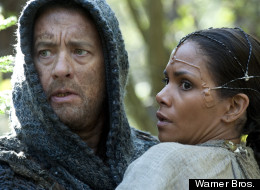
Reading about the filmmakers’ difficulty in securing funding, and their despair over the lack of originality in Hollywood studios’ vetting of films (recounted in this Huffington Post piece), made me root for this film. But then the next day I saw a picture in our local paper, in an article about upcoming fall films: Tom Hanks and Halle Berry in strange, half-primitive, half-futuristic make-up and costumes. And my heart sank.

It’s not that I don’t like these actors; I like them a lot. It’s just that they are so deeply connected, in my mind, with Hollywood, with fantasy and spectacle and a certain mindlessness when it comes to storytelling and entertainment. I couldn’t bear the thought of their assuming roles from this novel I’d so loved--the only novel I’ve finished in a flood of tears in a very long time. I couldn’t imagine their Hollywood bodies and faces in anything that wouldn’t diminish the experience of Cloud Atlas for me.

It’s partly that so much of the pleasure and power of Cloud Atlas the novel comes from its language. It’s difficult and unwieldy language at times, and it makes the kind of demands on a reader that so few (successful) creative works make today. Now people will know the novel as the source for a lavish--and, I’m sure, deeply moving--visual spectacle. But they probably won’t know it for its original, challenging, and heartbreakingly beautiful language. And I think that’s a terrible loss.

Here we are now, entertain us. Even that line from Nirvana is a dated reference now, I realize. But it still haunts me, in an age when college students can say that they enjoy “more traditional lectures”--by which they mean speakers who use a lot of Powerpoint. And that while we’re on that subject, why can’t they just watch the thing online?

The quiet pleasure of words, written or spoken: will we eventually lose this? Will I just be one of a handful of dinosaurs who mind?

Friday, August 3, 2012

The Game of Life

A new experience for me this summer: getting letters from my daughter at camp. Can there be anything more exhilarating than getting a letter from your almost-eleven-year-old that begins "The second day has been equal in its awesomeness to the first day"? She's having fun; I can relax.

In July I had two wonderful weeks in New England--first on Cape Cod with two of my oldest and dearest friends, Rita and Eva, to celebrate our "big birthday" this year. I'm not being coy; I just get tired of saying it. Let's just say that one of the books I took along was Tracey Jackson's Between a Rock and a Hot Place: Why Fifty Is Not the New Thirty. Another was Emma Donoghue's Room, which I'd wanted to read but kind of dreaded reading too (a cross between dread of reading about a child being held captive and, I'll admit it, dread of the inevitable envy of another writer's success). But it was every bit as good as I'd been told, surprising in a number of ways, and it made me feel the admiring kind of envy that I don't mind.

On the Cape we had fun biking, cooking, exploring different beaches and making lots of jokes about being middle-aged. (For example, our version of the Portlandia episodes where Lisa and Bryce put birds on things or exclaim "We could pickle that!" was our response to any leftover food item, at home or in a restaurant: "We could put that on a salad!" Middle-aged women love thrifty and creative salads). But I'm pleased to say there was also some good old-fashioned sexual humor, of the sort we might have indulged in while in college; ask my friend Eva for her interpretation of the name of the Dennisport, MA restaurant called The Wee Packet.

The second week was my yearly trip to Vermont with Jim and Anna, staying at the wonderful Pie in the Sky in Marshfield and enjoying time with friends who stay nearby. This was the year for playing The Game of Life with Anna and her friend Kathleen, who were both obsessed with it for some reason. Remember that board game? In one rendition I was a gay male in an orange car, starting out as a doctor making $70,000/year (presumably the version of the game we were playing was a few years old . . . though it did feature "Tech Support Person" as one possible job), then dropping to $30,000/year (no explanation, but I assumed malpractice of some sort), then switching careers, to sales, and making $60,000. I had a partner but never had kids or did anything with the cheap fixer-upper I bought--though I did install an expensive at-home gym. (Please remember that most of these "life choices" are based on the spaces you land on and the cards you draw, which might sort of be the point, in an existential sense; I'm not sure.) I retired to the place called Country Estates--not Millionaire Estates, where Anna and Kathleen both retired at the game's end--with a total of $635,000 in money and assets, as opposed to Anna and Kathleen's millions.

Here was something particularly intriguing: Though I wanted to play more recklessly, foregoing the purchase of car and home insurance and choosing not to repay my college loans (in other words, being the carefree person I've never quite been able to be), every time we played I felt incredible pressure to do these responsible things because the two ten-year-olds I was playing with kept purchasing every possible form of insurance and repaying loans as soon as they could. What was that all about?

Two photos here, one from a walk on the beach at Monomoy National Wildlife Refuge off the elbow of Cape Cod, one of the sun porch and barn at Pie in the Sky.


Wednesday, July 25, 2012

Summer Vacation

Nourishing myself, body and soul, during our annual week in Vermont right now. Here's a photo of breakfast a couple days ago (made with my daughter's help).