Joyce Hinnefeld

Blog

Friday, February 22, 2013

Recommended Reading--Cybercrime or Typical Academic Pettiness?


I’ve been fascinated by the story of Raphael Golb, who created countless online identities in order to address what he saw as biased and unjust attitudes toward his father’s scholarly work on the Dead Sea Scrolls, for several years now. In fact, when I first read about the discovery that Golb had created online aliases, blog posts, comments, etc. in order to smear his father’s rivals, his case became a kind of inspiration for parts of my current novel-in-progress. 

John Leland’s article in the Metropolitan section of last Sunday’s New York Times (“Online Battle Over Sacred Scrolls, Real-World Consequences”) is a sensitive and nuanced account of the whole affair. Mostly it strikes me as a sad story of two pretty unhinged men (both Raphael and his father Norman Golb). But it does raise interesting questions about First Amendment rights and academic debate, and what counts as criminal activity in the Wild West of the cyber-universe.

Saturday, January 12, 2013

Gaggle and Rookery

I was invited to offer the prayer at one of last December's Moravian College Christmas Vespers concerts. It's a gorgeous event each year, with my friend Paula Zerkle conducting the College Choir, and I was thrilled to join Chaplain Hopeton Clennon and others on the dais of Central Moravian Church that evening and look out on the sea of lit candles that fill the sanctuary and balcony at the end of the service.

Thought I'd share the prayer I wrote here, since it didn't actually have that much to do with Christmas per se. Somehow I managed to get birds in there instead.


To begin, the words of a Sabbath poem by writer Wendell Berry:

Teach me work that honors Thy work, 
the true economies of goods and words,
to make my arts compatible 
with the songs of the local birds

Teach me patience beyond work
and, beyond patience, the blest
Sabbath of Thy unresting love
which lights all things and gives rest.

Let us pray.

Dear Giver of light, and of rest; dear Source of pure songs rising from this dark season,

Thank you for these songs--these glorious voices, these cherished instruments, from quietest flute to unstopped organ. Thank you for the youthful hopes and dreams of our students, your children here and throughout the world, who sing and play and praise you, in sounds that are beautifully compatible with the songs of the local birds.

Sustain their hopes and dreams, with your unresting love, even in dark times.

With your unresting love, teach us all--all of us gathered here tonight, all of us throughout the world--to honor true economies of goods and words. To respect and revere both the makers of art and music and the makers, and maintainers, of our communities and our homes. Those who care for our children and our elders. Those who teach, those who govern, those who build, those who cook, and clean, and nourish. 

In this season of dark and quiet, teach us to rest in your unresting love. To acknowledge, and attend to, the needs of others. To attend to, and to value, the boundless gifts of the natural world. To listen with restful patience, and deep appreciation, to tonight’s sublime music, but also to the raucous cries of a gaggle of geese or a rookery of crows.

We are grateful to you for the opportunity to rest, tonight, in the beautiful light of this sanctuary and in these sounds of heartfelt praise. Help us, when we leave, to carry this light and these sounds with us, and to share both, in whatever ways we are able, with others.

Amen.


P.S.: I'm certainly no videographer, especially with an iPhone that I don't use very intelligently, but I did try recently to capture some of these remarkable groups of crows that descend on the treetops of center city Bethlehem at dusk each day. So I'll include that little bit of video here. (Pardon the roar of traffic; the fact that you can still hear the crows over the noise of cars gives you some sense of how loud they are.)


Tuesday, January 8, 2013

"I Thought You Were a Dwarf"


There are writers and artists that I turn to, often in the cold and dark winter months, to remind me of why it’s important to persist. Persist in the work of writing fiction, or any work of making something that isn’t particularly profitable. “Money dignifies what is frivolous if unpaid for,” wrote Virginia Woolf in A Room of One’s Own--not necessarily approving of this state of affairs, of course.

But there you have it: that nagging sense of something that’s “unpaid for” being frivolous. The reason, no doubt, that I devoted much more time to editing and then teaching, from my twenties through my forties, than to my own writing. 

There are ways to make money as a writer, but I haven’t been good at honing those skills. Jokes about “slutting it up” (in my friend and fellow Quaker Rick’s words at a meeting last night) and “inserting a vampire or two” aside, I seem constitutionally incapable of devising hair-raising plots. Or even--in language I’m hearing a lot of lately, as my agent begins submitting a new novel manuscript, with pretty clear trepidation-- “a strong through-line narrative.” I know, I want to tell her: Gone Girl it’s not. I’m sorry, but I don’t really think I can help it.

My impulse is to get whiny and defensive at these moments. Maybe to fall back on the old “They’d never say that to a man” response. (And yes, I can hear how hollow that rings in answer to the charge of a weak “through-line narrative.”) But how about the charge of “too much autobiography”--which, yes, I’ve already heard in response to this new manuscript. (What’s particularly upsetting is that this isn’t even true.)

But a better path, for me, than the angry, arched-spine, “when-did-you-last-say-something-like-that-about-a-male-writer’s-work” posture I’m prone to, is to read someone like Ursula Hegi, in a piece called “Did This Really Happen to You?” that appeared on the Glimmer Train site some time ago. “Giving a character one of my experiences changes the experience,” Hegi writes. “Brings me into the character from an angle I have experienced. Opens up anew the mystery of how it all comes together.”

Give me that “mystery of how it all comes together” over the manipulation of a heavily plotted thriller or vampire story any day. 

And also, please give me Ursula Hegi’s calm and gracious equipoise in the face of repeated versions of the question “Did this really happen to you?” When, after publishing Stones from the River, Hegi encountered readers who told her, “I thought you were a dwarf,” her answer was a simple one. She thanked them. 

Tuesday, December 11, 2012

Our Cat Litter Box, Exposed

I've been rethinking the photo showing the cat litter box on our little sun porch in this "Where Writers Write" post at The Next Best Book Blog . . . . Now it's online for perpetuity!

This is the kind of thing I think about too much: how ephemeral our digital lives are, and how alarmingly permanent at the same time.


Thursday, November 15, 2012

Writing and Napping

There have been some great tips from writers on the Unbridled Books tumblr page this month--in a feature inspired by National Novel Writing Month (NaNoWriMo). My advice is there too, under the heading "Write immediately . . . nap often"--which is a little deceptive, since my advice follows up on my only wishing I had time to take naps.

Anyway: there are lots of good ideas there, so check them out, whether you're writing a novel this month or not!

Sunday, September 30, 2012

Female Sidekicks in Fiction?


Attention Pacific Northwest readers and friends: I'll be at the Wordstock Festival in Portland, OR on Saturday, Oct. 13--reading with Lois Leveen at 2 PM, and on a panel on "literary sidekicks" with Kim Barnes and Martha Grover at 5 PM. See the Events page of my web site for details.

And readers and friends everywhere: Please help me as I try to put together some thoughts on "literary sidekicks." I'll be talking mostly about my characters Maze and Mary Elizabeth in Stranger Here Below, but I'm interested in other female characters who are friends (in novels or short stories), and particularly friendships that cross racial lines. I'm struck by the fact that I can think of all kinds of literary examples of male buddies/sidekicks, but it's harder to think of females (and hard in both cases to think of that many that cross the boundary of race). Sethe and Denver in Toni Morrison's Beloved, central characters in Alice Walker's "Advancing Luna--and Ida B. Wells," characters in Katherine Anne Porter's The Old Order. And who else? 

And why can I think immediately of female buddy films but not female buddy literary novels?

Tuesday, September 18, 2012

Entertain Us


The Wachowskis Cloud Atlas

Well, I’ve watched the trailer for the film of David Mitchell’s Cloud Atlas now, and I still can’t decide what I think.

I thought I must have misheard or misread when I got the news, somewhere, that the Wachowski siblings were making a film of the novel--which was published in 2004, and offered one of the most potent and moving reading experiences I’ve had in the last ten years. But then I read the Aleksander Hemon article in the September 10 issue of the New Yorker. 

I found that article exhilarating, probably because, for once, I was reading about the making of a movie through the eyes, and in the words, of a fine writer. Reading about Andy and Lana Wachowski and Tom Twyker’s experience in adapting the novel for the screen was exhilarating. Three smart, creative people, in love with a book and in love with film, working doggedly to bring it together--and this story told by a fourth smart, creative person. When I finished the article I had to get up and walk around for a while-- which is often my reaction to something creative and exciting.

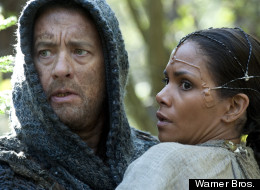
Reading about the filmmakers’ difficulty in securing funding, and their despair over the lack of originality in Hollywood studios’ vetting of films (recounted in this Huffington Post piece), made me root for this film. But then the next day I saw a picture in our local paper, in an article about upcoming fall films: Tom Hanks and Halle Berry in strange, half-primitive, half-futuristic make-up and costumes. And my heart sank.

It’s not that I don’t like these actors; I like them a lot. It’s just that they are so deeply connected, in my mind, with Hollywood, with fantasy and spectacle and a certain mindlessness when it comes to storytelling and entertainment. I couldn’t bear the thought of their assuming roles from this novel I’d so loved--the only novel I’ve finished in a flood of tears in a very long time. I couldn’t imagine their Hollywood bodies and faces in anything that wouldn’t diminish the experience of Cloud Atlas for me.

It’s partly that so much of the pleasure and power of Cloud Atlas the novel comes from its language. It’s difficult and unwieldy language at times, and it makes the kind of demands on a reader that so few (successful) creative works make today. Now people will know the novel as the source for a lavish--and, I’m sure, deeply moving--visual spectacle. But they probably won’t know it for its original, challenging, and heartbreakingly beautiful language. And I think that’s a terrible loss.

Here we are now, entertain us. Even that line from Nirvana is a dated reference now, I realize. But it still haunts me, in an age when college students can say that they enjoy “more traditional lectures”--by which they mean speakers who use a lot of Powerpoint. And that while we’re on that subject, why can’t they just watch the thing online?

The quiet pleasure of words, written or spoken: will we eventually lose this? Will I just be one of a handful of dinosaurs who mind?